Background of the Narrows
As early as the 1930’s it was agreed that Sanpete County needed water storage (we had none), and that Carbon County needed more water storage (Scofield was half its present size at the time).
Plans were made to build a storage reservoir in Sanpete, and to double the size of Scofield. Sanpete’s project was going to be built first, then Scofield expanded after that. Both counties were happy with the plan.
During World War II, it was discovered that Scofield was failing. A catastrophic failure of Scofield would do huge damage, including wiping out the railroad line that carried Carbon’s coal to Geneva Steel in Orem. The damage to Carbon’s economy, and to Geneva Steel’s contribution to America’s war effort was simply unacceptable.
So Sanpete agreed that Scofield should be expanded and repaired first. Sanpete’s water storage could wait.
Scofield was repaired, and doubled in size. World War II ended.
Then everyone — except the people of Sanpete — seemed to forget that Sanpete still needed the water project it was promised.
For the past 40+ years, every time Sanpete County has attempted to move its water project (the Narrows) ahead, the Carbon County Commission, the Carbon Water Conservancy district, the Price Water Users’ Association, etc. have objected.
The objections have ranged from questions about who owns the water, to environmental issues, to where the project should be located, and a host of other protests.
Every question has been well-answered, even by Utah’s Supreme Court and the US Department of Justice. Still, Carbon County (primarily the County Commission and Representative Jim Matheson) continue to object. (The other four members of Utah’s congressional delegation support the Narrows.)
On March 29, 2010, the Bureau of Reclamation’s Provo office released a Supplemental Draft Environmental Impact Statement (which we’ll refer to in this website as the SDEIS, or EIS). The publication of this document was a major milestone in the process of getting the Narrows built. The next major step toward the Narrows will be Bureau of Reclamation issuing what we hope will be a favorable Record of Decision, likely in the Spring of 2012.
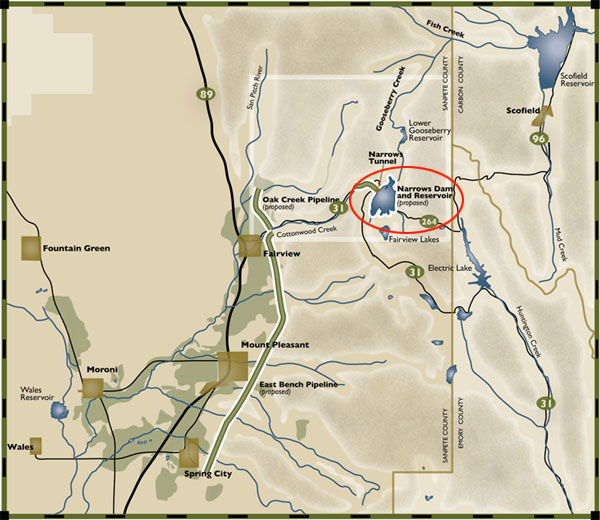
Where is the Narrows?
Narrows Dam and Reservoir
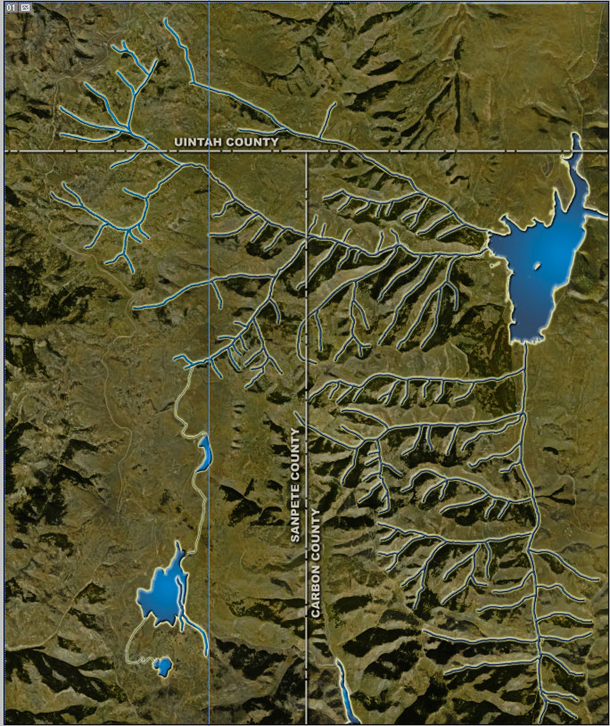
Water Flow
What Can I Do To Help?
The things you can do to support the Narrows right now are to:
- Voice support for it when you visit with elected officials (whether local, county, state or national).
- If you have acquaintances who live in Carbon County, or who belong to various environmental groups, seek their support for the Narrows. Arguments are seldom productive, but telling people rationally how important the Narrows is to Sanpete’s well-being can be helpful.
- Write to Utah’s congressional delegation in Washington D.C. Addresses are provided below.
Narrows supporters provided a substantial amount of favorable comment about the Narrows to The Bureau of Reclamation as Reclamation prepared the Environmental Impact Statement that was issued in November 2012. (Of course, Carbon County and environmental interests submitted a significant number of objections, as well.) Thank you for that support!
Here are some ideas you may want to consider as you talk or write about the Narrows. But remember, your original thoughts are best.
- Sanpete County has been promised a water storage facility (the Narrows Project) for decades. Our county desperately needs the water storage that would be provided by the Narrows Dam and Reservoir. Once the snow pack has melted and runs past the communities and farms, Sanpete is out of water for the year.
- Sanpete has invested heavily over the years to consider various sites for the Narrows. The current proposed site is the most ideal, would cost least to construct the dam, would require no pumping costs, and would be the least costly to maintain. The Narrows should be built where proposed, as proposed.
- The Narrows, as presently proposed by the Sanpete Water Conservancy District, will cost less to build, is a far better dam site, will do a better job of providing the needed water, and will provide other public benefits (recreation and a fishery) that the suggested alternatives do not.
- Ultimately, water supply is the critical issue. People–and their need for water–are far more important than any issues that may lead one to believe the Narrows should not be built. Sanpete County badly needs the water storage that would be denied us should the Narrows not be built.
- The Narrows has been promised to Sanpete for nearly 80 years.
- In the 1930’s, water storage was promised to Sanpete County, and the doubling of Scofield Reservoir for additional water storage was promised to Carbon County. Carbon received their 30,000 acre-feet of additional water storage; Sanpete has yet to receive the 5,400 acre-feet we were promised.
- Sanpete County clearly owns the water rights involved. The Utah Supreme Court and the US Department of Justice have both acknowledged Sanpete’s water rights.
- Construction of the Narrows will have a very favorable jobs impact, creating 369 job years of employment, almost exclusively for Utahns, particularly residents of Sanpete and surrounding counties1. That’s the equivalent of 369 jobs that last a full year, or 185 jobs that last two years, or 123 jobs that last three years, etc.
- After construction, the Narrows will create about $1 million per year of economic benefit, primarily in Sanpete County. This economic benefit is anticipated to continue for 100 years, likely longer2.
- The Narrows will provide substantial recreation benefits (fishing, boating, camping, and general outdoors activities) for the residents of Sanpete, Carbon, Millard and other counties.
- The budget to create the Narrows includes a substantial amount to mitigate environmental, recreational and other issues that may be impacted by building the dam and reservoir. From environmental and recreational perspectives, the area surrounding the Narrows will be left in a much-improved condition.
- The federal government spends money on issues that seem frivolous when compared to people’s need for water to earn a living. For example, in/near Utah Lake, over $40 million has been spent to protect the June Sucker. Consider priorities, please. Isn’t water for people more important than something like the June Sucker? The entire Narrows Project will cost less, and the funds will be repaid by sale of the stored water.
- Sanpete County has a significant water shortage, which is likely to only get worse.
- Well-researched documents conclude that, “…a combination of conservation, new water development and new storage facilities need to be implemented to reduce on-going water shortages.” Sanpete has been making those same points for over seventy years.
- Water conservation is a very important element of the solution to the water shortage problem. Sanpete County has aggressively implemented water conservation infrastructure and techniques for many years which have saved 8,000 acre-feet of water so far. We will continue to conserve, and anticipate saving more water. But conservation alone will never–no matter how effectively done–alleviate the problem, particularly in Northern Sanpete County.
- Reclamation’s Final EIS points out that new water development is necessary.
- The EIS points out that new storage facilities need to be implemented. Sanpete has dedicated a huge amount of energy, financial and emotional resources for many years to identifying the most appropriate, effective and environmentally-friendly means of storing water. The Narrows Dam and Reservoir best fulfills those objectives. Many independent engineering studies (that far pre-date the Final EIS) agree with the Final EIS’s observations and conclusions.
- Carbon County has suggested that if this project goes forward, Price & other Carbon County communities will be left with insufficient water; not even enough, they say, to fight fires. Carbon has received all the water it was promised. It is Carbon’s responsibility to determine how to best operate their water resources (Scofield) such that they can take care of their highest priority needs first. It’s not up to Sanpete to tell them how, or to provide them with the water to do so. It’s Carbon’s responsibility to decide how to meet their priorities. Right now, they’re doing it with Sanpete’s water.
- Some have expressed concerns about the Narrows’ impact on the water quality in Scofield Reservoir. Plans and budgets for the Narrows include measures to mitigate any impact that might be caused by the Narrows Project. In fact, it appears that Sanpete is over-mitigating, and is not obligated to do as much mitigation as is planned. We’re doing it to be responsible stewards, and good care-takers of our lands and lands around us. But there comes a point when enough is enough. Total mitigation dollars budgeted are upward of $4 million. Over 10% of the Narrows Project budget is mitigation & recreation.
- Yes, species such as mule deer and Brewer’s Sparrow (mentioned in the EIS as a concern) are important. But storing water to enable Sanpete residents to farm and have residential water is more important.
- As of January 3, 2013, Reclamation has approved the use of Reclamation-withdrawn lands for the Narrows Project.
- A perpetual easement should be granted for the construction, operation and maintenance of the Narrows.
- Encourage those with whom you speak to maintain perspective. The proposed location of the Narrows is nothing more than a large, flat pasture with a small steam meandering through it. Putting a reservoir there would greatly enhance the functional and aesthetic quality of that area. Whatever animal or plant life that might be disturbed are either expendable, or would regrow elsewhere.
- Carbon County received its additional water storage in the 1940’s (strengthening and doubling the size of Scofield). The US Department of the Interior, and Carbon County agreed (in writing in 1943) that Sanpete would get water storage as well. The Narrows is that project. It’s time to make good on the promises made to Sanpete County.
- The State of Utah agrees that the Narrows should be built. Utah’s House of Representatives and State Senate passed Resolutions in 2008 and 2009. The State’s Natural Resources experts and the State Engineer agree that the Narrows should be built. In 1984, Carbon County agreed–in writing–that the Narrows Project should be built, and agreed not to oppose it.
- Sanpete is being very careful with the water we have. In an independent study, Utah State University recognized Sanpete County as a leader in water conservation measures.
- Every reasonable alternative to the Narrows has been considered. There are no alternatives that are as productive, cost-effective, or environmentally-friendly as the proposed Narrows site.
1 Based on Office of the President Council of Economic Advisors estimates.
2 Based on US Department of Agriculture Economic Research Service projections.
New Jobs for Sanpete and Other Counties
When construction of the Narrows begins, it will create several hundred new jobs. Equipment operators, engineers, truck drivers, laborers, managers and a variety of others will be needed to build the dam and reservoir, the nearby campground, boat ramp and other recreation facilities, and to re-locate a section of State Road 264.
As much as possible, local people will be hired to do these jobs.
Total budget to build the Narrows is $34 million. Based on statistics provided by President Obama’s Council of Economic Advisors, a project that size will require 369 man-years to build (the amount of work one man can accomplish in 369 years).
Thus, if 369 people were hired, it would take one year to do the work. If 185 people were hired–a more likely number–it would provide two years of employment for those 185 people.
The Sanpete Water Conservancy District (the organization which will build and manage the Narrows Project) is firmly committed to giving first hiring priority to citizens of Sanpete and other nearby counties when the project is built. The money spent to build The Narrows should benefit local families and businesses to every possible extent.